












































FSC FCOC47059 . FSC is dedicated to the promotion of responsible forest management
worldwide. By selecting this product, you help take care of the woorld's forests

UL-certified for indoor drying environments not directly exposed to excessive moisture or water;
Use in the United States and Canada.

Certified to Dry ETL electrical standard: suitable for use indoors in dry locations not directly exposed to excessive moisture and water
Use in the United States

CE-certified drying equipment compliant with electrical standards: Suitable for indoor drying environments not directly exposed to excessive moisture or water;
Tested for use in Europe, the UK, and other regions.


The support center has answers to questions you may have. You can also contact customer service in the support center if you can't find what you're looking for.
Support Center >
At houlte, we are committed to delivering quality, style, and great value to our customers. Our goal is to simplify your shopping experience by providing competitive prices and exceptional service.

If an item you purchased from houlte goes on sale on our website within 30 days of your purchase date, you may request a price match. This policy ensures you always receive the best value when shopping with us.
Houlte reserves the right to interpret and adjust the terms of the Price Match Policy as necessary.
Houlte has partnered with Taskrabbit to make your everyday life at home easier by connecting you with flexible and affordable ways to get your to-do’s done including furniture assembly and mounting.

1. Purchase your furniture at Houlte.
2. Check your order Dispatched and Delivered email and click the
Houlte link. You will be redirected to Taskrabbit's landing page.
3. Post your task on Taskrabbit platform.
4. Pick the best tasker to assemble your furniture.
Houlte has partnered with Taskrabbit to make your everyday life at home easier by connecting you with flexible and affordable ways to get your to-do’s done including furniture assembly and mounting.
Taskrabbit Assembly is available in most metro areas in the US. The availability of Taskers varies based on demand. When placing an order on Taskrabbit, you will need to enter your zip code. If the service is not supported in your area, you will not be able to place an order.
You can book assembly for your Houlte furniture as early as the next day after your delivery, and up to 14 days in advance, giving you flexibility to choose a time that works best for you.

Ready to use out of the box; minimal installation may be required (e.g., handles).

Main structure is pre-built; minor components require attachment (e.g., legs).

Assembly required; multiple parts must be assembled before use.
Our furniture is built with a combination of core boards, real wood veneers, and selected solid wood parts. Each material is used for a different purpose—structure, surface appearance, or visible strength—so the final piece feels balanced in performance, finish, and cost.
Core boards form the internal foundation of the furniture. They provide structure, stability, and efficiency across large surfaces and cabinet bodies.

Stable structural board

Smooth and consistent

Functional internal board
Selected solid wood parts are used where visible strength, tactile quality, and structural integrity matter most—such as legs, frames, trim, and exposed support details.

Durable and classic

Light and versatile

Premium and elevated
If you ask us whether nightstands have to match, our honest answer is simple: no, they do not. But they do need to make sense together.
That distinction is what matters.
For years, matching nightstands were treated as the default bedroom formula—same size, same finish, same hardware, one on each side of the bed. It is tidy, familiar, and easy to get right. But bedroom design in 2026 is far more flexible than that. We are seeing more rooms built around balance rather than strict symmetry, and more homeowners choosing pieces that feel collected instead of purchased as a set.
So the real question is not "Do nightstands have to match?"
It is: "What kind of visual relationship do I want beside the bed?"
| Question | Short Answer |
|---|---|
| Do nightstands have to match? | No. Matching is optional, not required. |
| Can two different nightstands still look intentional? | Yes, if they share a common thread such as height, tone, material, or shape. |
| Is one nightstand enough? | Absolutely—especially in small rooms, guest rooms, or asymmetrical layouts. |
| Do nightstands need to be symmetrical? | Not necessarily. Visual balance matters more than identical placement. |
| Are matching nightstands outdated in 2026? | No, but they are no longer the only "right" choice. |
The traditional bedroom setup favors a pair of matching nightstands, one on each side of the bed. We understand why this format has endured for so long: it creates order immediately.
Matching nightstands typically offer a clean, symmetrical look, a sense of structure around the bed, easier coordination with dressers and bedroom sets, and equal function for both sides of the bed. This approach works especially well in primary bedrooms where symmetry feels calming and the architecture of the room is already balanced.
The more modern approach is less about duplication and more about dialogue. Nightstands do not have to be identical to feel connected. In fact, some of the most interesting bedrooms use two different pieces that share one or two clear design cues. That might mean the same height but different materials, different silhouettes in a similar finish, one enclosed nightstand and one lighter side table, or two distinct pieces linked by matching lamps or hardware tones. We tend to like this approach when a room needs character, softness, or a more lived-in point of view.
| Type | Details |
|---|---|
| Pro | Easy to coordinate, visually calm, symmetrical, classic, ideal for shared bedrooms |
| Pro | Creates a polished "finished" look with minimal styling effort |
| Con | Can feel expected or overly formal |
| Con | Less flexible if each side of the bed has different needs |
| Con | Sometimes makes the room feel more like a furniture set than a personal space |
| Type | Details |
|---|---|
| Pro | Feels curated, more flexible, often more interesting visually |
| Pro | Lets each side of the bed function differently |
| Pro | Helpful when room dimensions or storage needs are uneven |
| Con | Easier to get wrong if height and scale are ignored |
| Con | Can look accidental instead of intentional without a common thread |
| Con | Requires more attention to styling and proportion |
We think nightstands are often underestimated because they are relatively small. But in a bedroom, they do a remarkable amount of work. They frame the bed, influence circulation, manage visual clutter, support daily routines, and often determine whether the room feels balanced or unresolved.
In other words, nightstands are not just accessories. They are functional anchors. That is exactly why the matching versus non-matching decision matters. It is not just about style preference. It affects how the bedroom feels to live in.
If your room is highly architectural and clean-lined, matching nightstands may reinforce that clarity. If your room is softer, more layered, or more personal, mixed nightstands can help it feel less rigid and more relaxed.
Before deciding whether your nightstands should match, we always recommend evaluating the fundamentals first.
This is where the decision should start.
A nightstand should usually sit close to mattress height, ideally level with the top of the mattress or within about 2 inches above or below it. If two non-matching nightstands differ too much in height, the room can feel off even if the styles are beautiful individually.
Wider nightstands feel more substantial and offer more usable surface area. Narrower ones are often better for tighter rooms. If you are mixing styles, width can vary somewhat, but the difference should still feel deliberate.
Most nightstands fall in a practical range that allows enough surface function without crowding the bed path. Too deep, and the bedside area starts to feel cramped. Too shallow, and everyday usability suffers.
This is where matching sometimes stops making sense. Not every sleeper uses the bedside area in the same way. One side may need two drawers, concealed charging storage, or room for books and glasses. The other side may only need a lamp, a coaster, and a place for a phone.
That is why non-matching nightstands can be so practical. They allow the room to respond to real-life routines instead of following a rigid furniture rule.
When mixing nightstands, we look for continuity somewhere. The easiest ways to create that are through similar wood tones, related undertones, repeated stone or metal accents, matching hardware finishes, or a shared level of visual weight. For example, two nightstands do not have to be the same design if both carry a refined material story—say, warm wood, subtle stone, or sculptural detailing.
Many people ask whether the nightstands should match the bed or the dresser. Our answer: they do not need to match exactly, but they should coordinate with at least one of them.
The goal is cohesion, not uniformity.
| Bedroom Situation | Matching Nightstands | Non-matching Nightstands |
|---|---|---|
| You want a calm, hotel-like look | Excellent choice | Can work, but requires restraint |
| Your room is small or asymmetrical | Sometimes too rigid | Often more adaptable |
| You and your partner need different storage | Less flexible | More practical |
| You like collected, layered interiors | Can feel too formal | Usually the better fit |
| You prefer classic symmetry | Best option | Possible, but less natural |
| You want a more current 2026 look | Still valid | Often feels fresher |
If we are mixing bedside pieces, we do not try to force sameness. We try to create rhythm.
This is the single most important rule. Your nightstands can differ in silhouette, drawer count, or detailing—but they should still share something. That common thread might be similar height, a consistent finish family, repeated curves or lines, the same material category, matching lamp scale, or parallel visual weight. Without a shared thread, mixed nightstands tend to read as random.
We usually recommend pairing contrast with restraint. A few combinations we like:
Balance does not mean equal detail on both sides. It means each side contributes appropriately to the room.
You can vary shape more easily than you can vary height. Curved and rectilinear can work. Wide and narrow can work. Fluted and flat-front can work. But dramatically mismatched heights usually do not.
If you want to experiment, keep one dimension stable—typically height—and allow the silhouette or finish to shift around it.
Below are three Houlte options we would naturally consider depending on the bedroom direction. We are not suggesting them as forced inserts or as a set. We are suggesting them because each supports a different answer to the matching debate.
| Product | Best For | Why We'd Use It |
|---|---|---|
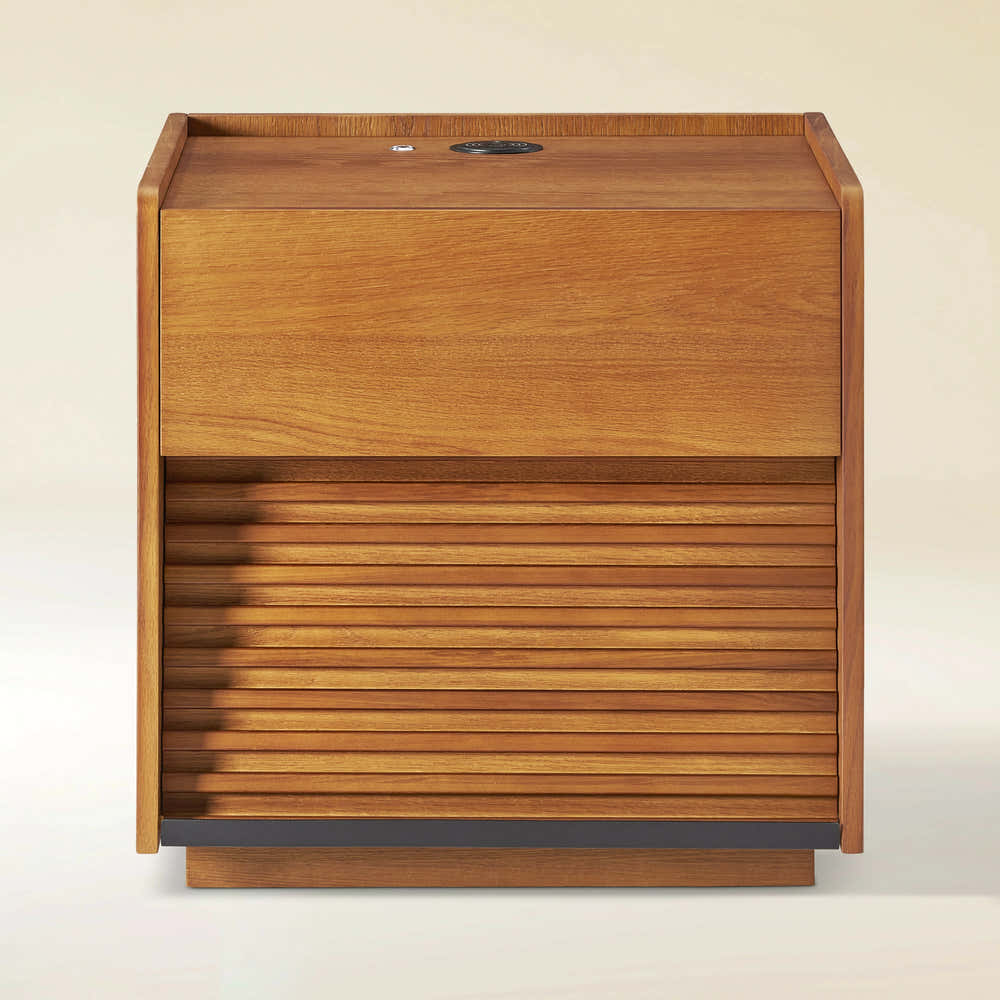
| Riley Nightstand 30″ | Traditional or semi-traditional matching setups | Rich wood tone and grounded proportions give a bedroom a stable, symmetrical framework |
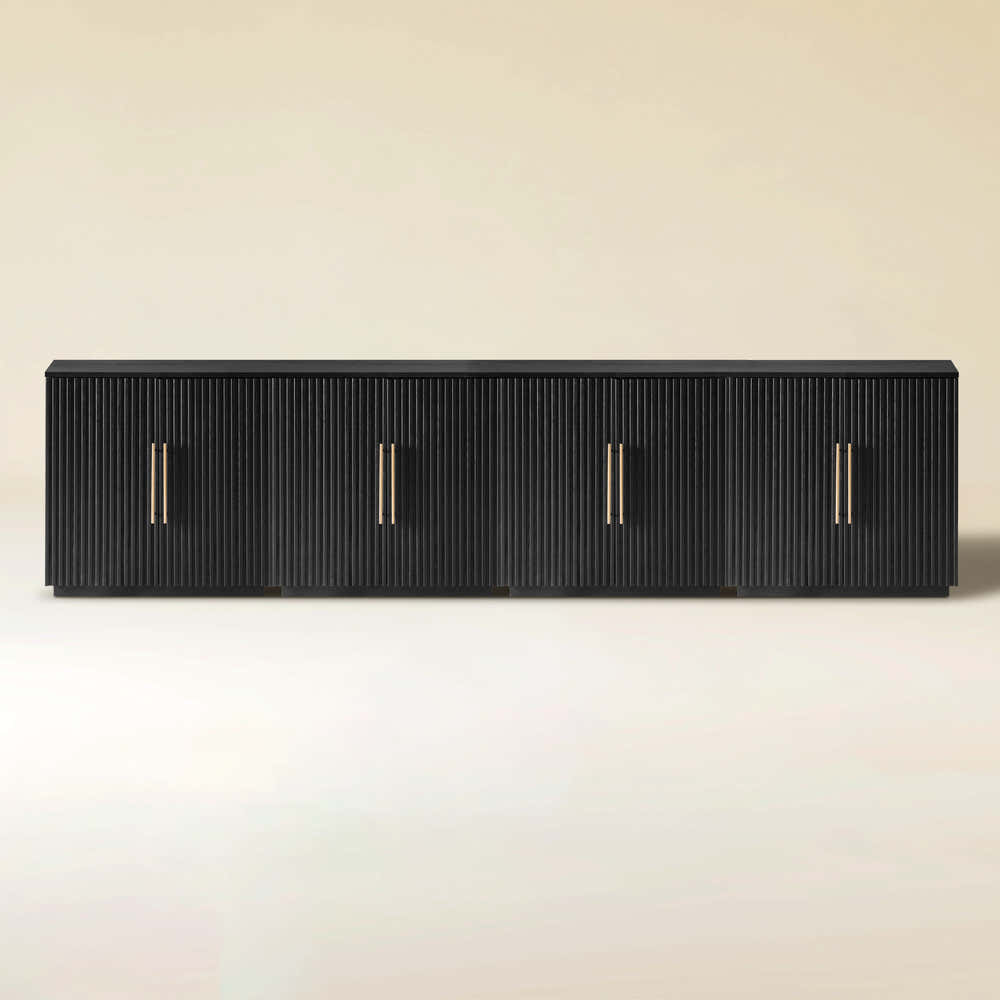
| Sinclair Fluted Stone Nightstand 30″W | Statement-driven, more architectural bedrooms | A sculptural silhouette works beautifully when you want one or both sides of the bed to feel elevated and distinct |
| Celia Burnt Stone Nightstand 20″ | Smaller rooms or intentionally mixed bedside layouts | The compact width makes it useful when one side of the bed needs a lighter footprint without sacrificing refinement |
If we wanted a bedroom to feel calm, tailored, and easy to style, we would lean toward a pair of the Riley Nightstand 30″. It fits the classic instinct for matching without feeling dated.

Rich wood tone and grounded proportions give a bedroom a stable, symmetrical framework without feeling dated.
View product →If we wanted the room to feel more design-forward, we would look at the Sinclair Fluted Stone Nightstand 30″W—especially in a bedroom where texture, lighting, and material contrast are already doing important work.

A sculptural silhouette works beautifully when you want one or both sides of the bed to feel elevated and distinct.
View product →And if we were solving for an uneven layout, limited floor space, or a more relaxed asymmetrical composition, the Celia Burnt Stone Nightstand 20″ would be the kind of piece we would bring in on the tighter side of the bed.

The compact width makes it useful when one side of the bed needs a lighter footprint without sacrificing refinement.
View product →For a broader browse, you can explore the full Houlte nightstand collection:
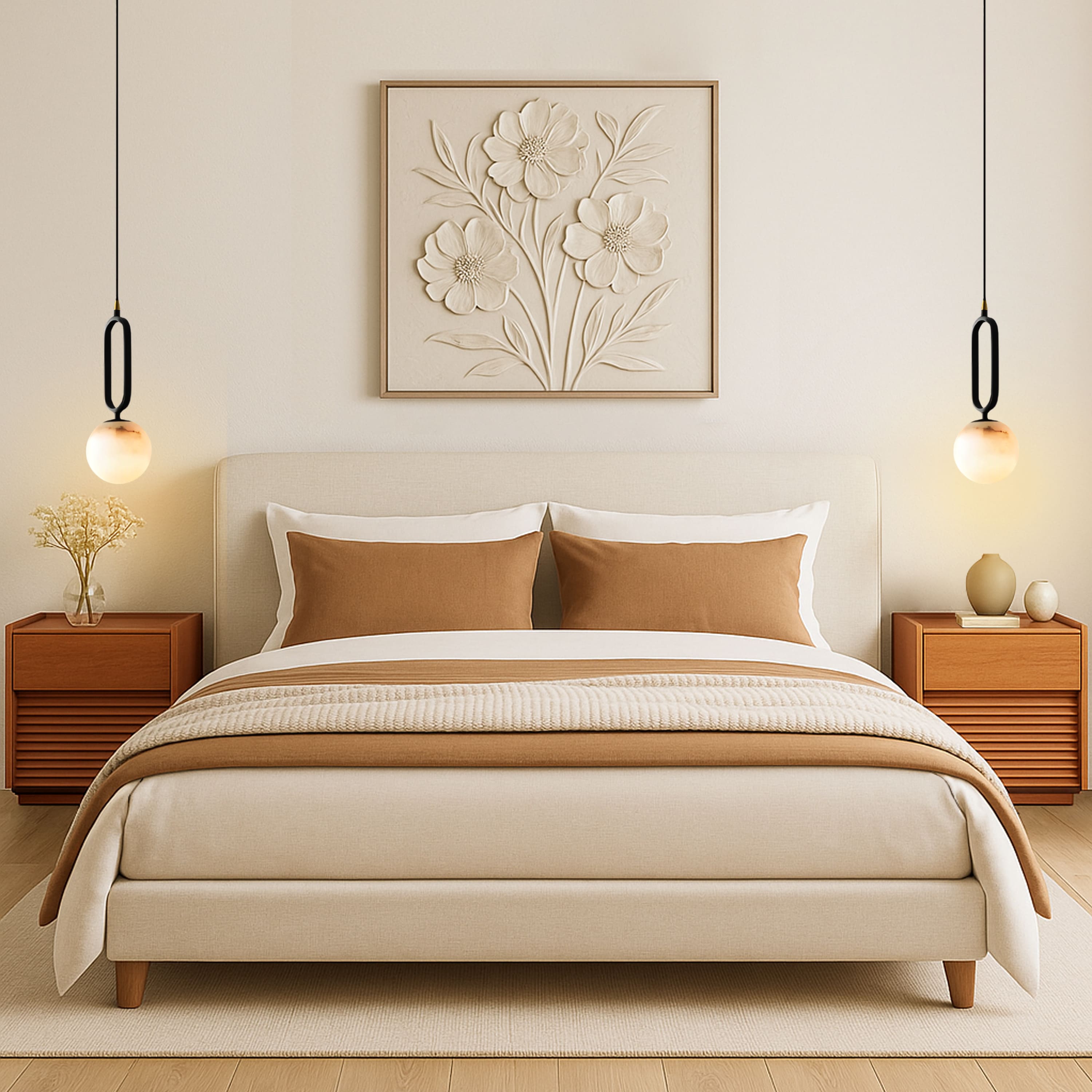
Browse all nightstands →Two matching nightstands + two matching lamps. Best when you want a polished primary bedroom, a symmetrical layout, and an easy, timeless result.
Two different nightstands + matching lamps. Best when you want character without chaos—the furniture varies, but the lighting unifies the scene.
One larger storage nightstand + one smaller accent nightstand. Best when one side needs more function, the room is tighter, or you want the layout to reflect how you actually live.
Some bedrooms benefit from the serenity of symmetry. Others come alive when the two sides are allowed to differ a little. We do not see one approach as more correct than the other. We see them as tools for shaping mood, function, and personality.


Share:
Can You Use Outdoor Lights Indoors? A Comprehensive Guide
What Color Nightstands Pair Best with a Dark Wood Bed?