












































FSC FCOC47059 . FSC is dedicated to the promotion of responsible forest management
worldwide. By selecting this product, you help take care of the woorld's forests

UL-certified for indoor drying environments not directly exposed to excessive moisture or water;
Use in the United States and Canada.

Certified to Dry ETL electrical standard: suitable for use indoors in dry locations not directly exposed to excessive moisture and water
Use in the United States

CE-certified drying equipment compliant with electrical standards: Suitable for indoor drying environments not directly exposed to excessive moisture or water;
Tested for use in Europe, the UK, and other regions.


The support center has answers to questions you may have. You can also contact customer service in the support center if you can't find what you're looking for.
Support Center >
At houlte, we are committed to delivering quality, style, and great value to our customers. Our goal is to simplify your shopping experience by providing competitive prices and exceptional service.

If an item you purchased from houlte goes on sale on our website within 30 days of your purchase date, you may request a price match. This policy ensures you always receive the best value when shopping with us.
Houlte reserves the right to interpret and adjust the terms of the Price Match Policy as necessary.
Houlte has partnered with Taskrabbit to make your everyday life at home easier by connecting you with flexible and affordable ways to get your to-do’s done including furniture assembly and mounting.

1. Purchase your furniture at Houlte.
2. Check your order Dispatched and Delivered email and click the
Houlte link. You will be redirected to Taskrabbit's landing page.
3. Post your task on Taskrabbit platform.
4. Pick the best tasker to assemble your furniture.
Houlte has partnered with Taskrabbit to make your everyday life at home easier by connecting you with flexible and affordable ways to get your to-do’s done including furniture assembly and mounting.
Taskrabbit Assembly is available in most metro areas in the US. The availability of Taskers varies based on demand. When placing an order on Taskrabbit, you will need to enter your zip code. If the service is not supported in your area, you will not be able to place an order.
You can book assembly for your Houlte furniture as early as the next day after your delivery, and up to 14 days in advance, giving you flexibility to choose a time that works best for you.

Ready to use out of the box; minimal installation may be required (e.g., handles).

Main structure is pre-built; minor components require attachment (e.g., legs).

Assembly required; multiple parts must be assembled before use.
Our furniture is built with a combination of core boards, real wood veneers, and selected solid wood parts. Each material is used for a different purpose—structure, surface appearance, or visible strength—so the final piece feels balanced in performance, finish, and cost.
Core boards form the internal foundation of the furniture. They provide structure, stability, and efficiency across large surfaces and cabinet bodies.

Stable structural board

Smooth and consistent

Functional internal board
Selected solid wood parts are used where visible strength, tactile quality, and structural integrity matter most—such as legs, frames, trim, and exposed support details.

Durable and classic

Light and versatile

Premium and elevated
When we're designing a bedroom, nightstand height is one of those details that quietly changes everything. Get it right, and the whole bedside experience feels natural: your book is easy to reach, your glass of water sits at the right level, your lamp works properly, and the bed feels visually balanced. Get it wrong, and even a beautiful room can feel slightly off.
In our view, choosing the right nightstand height is not just about following a formula. It's about comfort, proportion, and how the bed, mattress, lighting, and room architecture all relate to one another. This guide is the way we think about it at Houlte.
If we had to give one guiding principle, it would be this:
A nightstand should usually sit level with the top of the mattress or up to a couple of inches higher.
That's the range that tends to feel most comfortable in daily use.
For most bedrooms, we like to work within this range:
As a general rule, the best nightstand height is flush with the mattress top, or about 1–2 inches above it. If a nightstand sits too low, you have to reach down awkwardly. If it sits too high, it can feel intrusive and visually top-heavy beside the bed.
We don't choose bedside height in isolation—we look at the room's overall language.
The bed itself is always our starting point. If the bed has strong height or visual presence, the nightstand should support it rather than disappear beside it.
| Bed Type | Nightstand Approach |
|---|---|
| Platform bed | Lower nightstands pair best |
| Standard upholstered bed | Works with most standard heights |
| Tall bed / thick mattress | Often needs a taller bedside piece |
| Four-poster / canopy bed | More substantial nightstand for visual proportion |
This is one of the most common bedside questions, and our answer is: slightly higher is often better than lower—but only slightly.
The bedside surface should be easy to reach without lifting your shoulder or dropping your arm too far. That convenience matters more than people think.
| Relationship | Feel & Practicality |
|---|---|
| Same height as mattress top | Ideal and balanced |
| 1–2 inches higher | Often very comfortable and visually crisp |
| 1–2 inches lower | Can still work, especially with low beds |
| Much lower or much higher | Usually feels less practical |
Platform beds change the equation a little because they often sit lower to the ground and create a more horizontal, modern profile. For platform beds, we generally prefer lower nightstands with simpler silhouettes, less bulk, and a clean visual line beside the mattress.

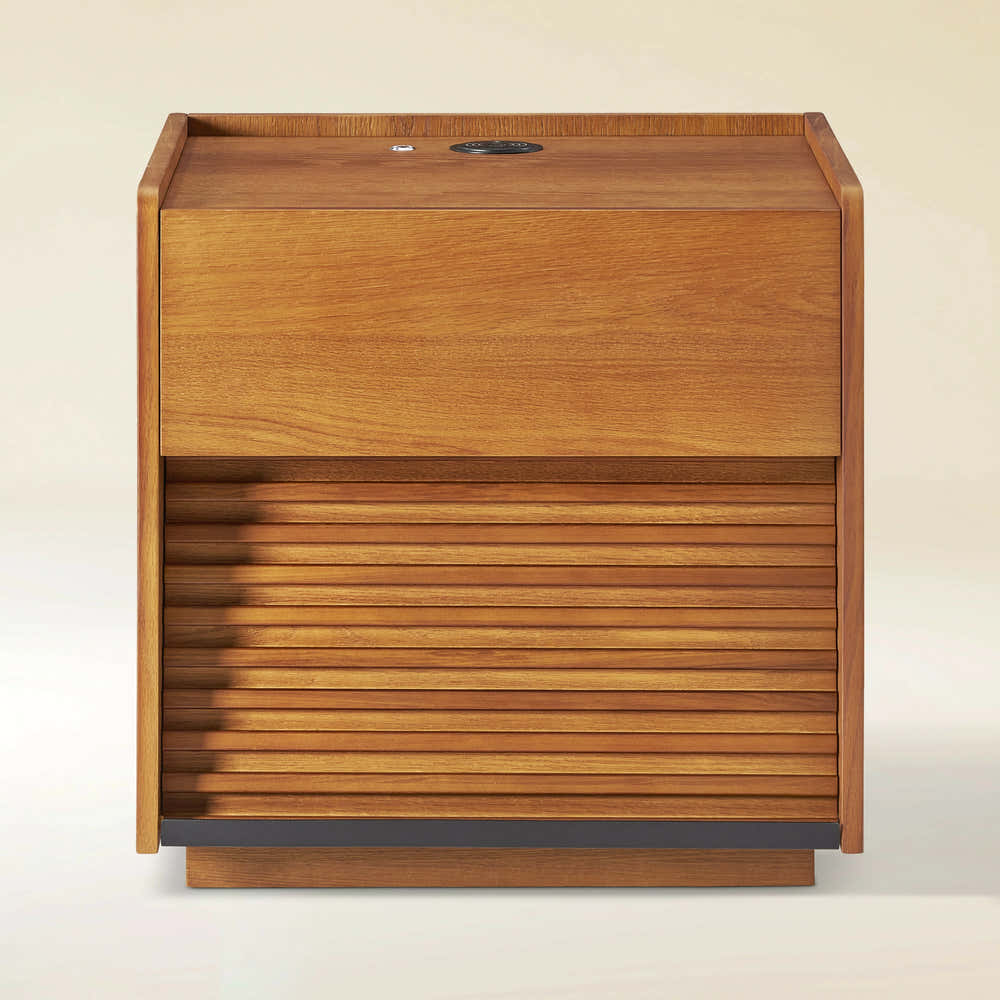
Recommended for Platform Beds
19.7" H
Works especially well in lower-profile bedrooms where you want the bedside to feel calm, architectural, and close to the mattress line rather than towering above it.
There is no single official standard, but there is a range that we see again and again in well-proportioned bedrooms.
Most nightstands fall somewhere between 20 and 30 inches high, with the most common range sitting at 22 to 26 inches. That middle zone works with many standard bed and mattress combinations, which is why it appears so often.
From the Houlte collection, we see this same variety reflected in practice:
| Nightstand | Height | Best Suited For |
|---|---|---|
| Isla Nightstand | 19.7" | Low-profile & platform beds |
| Devon Oak Nightstand | 19.69" | Minimal & modern bedrooms |
| Silas Nightstand 24" | 21.7" | Standard & transitional setups |
Mattress thickness changes bedside proportion more than many people expect. We always recommend measuring from the floor to the top of the mattress, not just to the bed frame.
| Mattress Type | Recommended Approach |
|---|---|
| Thin mattress / low modern bed | Use a lower nightstand |
| Standard mattress | Most standard heights will work |
| Pillow-top or hybrid mattress | May need something taller |
| Box spring + mattress combo | Bedside height usually needs to rise accordingly |
Our process is simple: measure first, then judge visually.
Here's the method we use:
This one measurement solves most bedside sizing uncertainty. Use the quick reference below:
We don't stop at measurement. We also ask: Does the nightstand feel too small beside the headboard? Does it visually support the bed? Is there enough top surface for what you use nightly? Does the room feel balanced from left to right?
In a room with a tall upholstered headboard, a very low nightstand can feel underscaled even if it technically aligns with the mattress. In a smaller bedroom, the opposite can happen: a nightstand may be proportionally correct to the bed but too bulky for the room. That's why proportion always matters as much as raw height.
There is no universal winner here. The better choice depends on what you need the bedside to do.
We often like taller nightstands when the bedroom needs more function. They can offer more drawer storage, stronger visual presence, better compatibility with taller mattresses, more surface height for lamps and everyday items, and a more tailored, furniture-like look. If the room is spacious and the bed has presence, a taller nightstand can help everything feel grounded and intentional.

Recommended for Taller Beds & More Storage
Its more substantial presence makes sense in bedrooms where you want bedside storage to feel like part of the room's architecture, not just an accessory. Suits spaces with taller beds and a need for bedside function.
Low-profile nightstands have their own strengths. We tend to choose them when we want a more minimal look, a lighter room feel, better proportion with low beds, visual calm in smaller bedrooms, and less furniture mass beside the bed. They are especially effective in modern bedrooms where restraint is part of the mood.

Recommended for Low-Profile & Minimal Bedrooms
19.69" H
Its lower height works beautifully when you want the bedside area to stay open, streamlined, and understated—especially natural in modern bedrooms where restraint defines the mood.
We rarely make bedside decisions on height alone. Comfort and room balance matter just as much.
A good nightstand should make bedtime easier. We consider whether you can comfortably reach a lamp switch, a glass of water, your phone, a book, an alarm clock, and nighttime essentials. If the surface is too low, daily use becomes subtly inconvenient. If it's too high, it can feel like the piece is crowding the bed.
A nightstand is not an isolated object. It is part of a composition with the bed, the headboard, the lamp or sconce, the rug, the wall space, and the circulation path. We often find that bedrooms feel "off" not because the furniture is bad, but because the scale conversation between these pieces is unresolved.
In smaller bedrooms, lower and visually lighter nightstands can prevent crowding. In larger bedrooms, something too small may feel timid and unfinished.
From a feng shui perspective, the most commonly recommended approach is for the bedside table to sit at the same height as the mattress, or very close to it. That alignment is often associated with a sense of harmony, stability, and ease.
Even outside feng shui, we find that this principle holds up well in design. Matching or nearly matching the mattress height creates a calmer visual line and makes the bedside feel intentional rather than accidental. If a bedroom is being designed with symmetry and serenity in mind, this is usually an excellent place to begin.
Our favorite rule of thumb is to keep the nightstand level with the mattress, or 1–2 inches higher. For width, it should feel proportional to the bed and still leave enough room to move comfortably around the space.
It can be—slightly. We generally think up to 2 inches higher is perfectly fine and often very practical. Much higher than that usually feels less balanced.
Most standard nightstands fall between 20 and 30 inches high. The most common range is usually 22 to 26 inches.
For a four-poster bed, we usually recommend looking not only at mattress height but also at the visual scale of the bed itself. Because four-poster beds often feel taller and more architectural, a nightstand with a bit more presence usually works better than a very low one. Start with mattress height, then make sure the bedside piece doesn't feel dwarfed by the frame.
The nightstand should still relate first to the mattress, but lamp height matters too. Ideally, when you're sitting up in bed, the lower part of the lampshade should be around eye level or just slightly below, so the light feels comfortable rather than glaring. A very tall lamp on a very tall nightstand can quickly become too much.
When we choose a nightstand, we're really choosing how the bed meets the room. Height is what makes that relationship feel effortless.
If we had to reduce it to one sentence, it would be this:
Measure to the top of your mattress, then choose a nightstand that meets it there—or rises just slightly above it.
That one move will solve most bedside proportion problems before they start.



Share:
The Definitive Guide: Difference Between a Sofa and a Couch
Understanding Bookcases: Definition, Differences, and Trends