











































FSC FCOC47059 . FSC is dedicated to the promotion of responsible forest management
worldwide. By selecting this product, you help take care of the woorld's forests

UL-certified for indoor drying environments not directly exposed to excessive moisture or water;
Use in the United States and Canada.

Certified to Dry ETL electrical standard: suitable for use indoors in dry locations not directly exposed to excessive moisture and water
Use in the United States

CE-certified drying equipment compliant with electrical standards: Suitable for indoor drying environments not directly exposed to excessive moisture or water;
Tested for use in Europe, the UK, and other regions.


The support center has answers to questions you may have. You can also contact customer service in the support center if you can't find what you're looking for.
Support Center >
At houlte, we are committed to delivering quality, style, and great value to our customers. Our goal is to simplify your shopping experience by providing competitive prices and exceptional service.

If an item you purchased from houlte goes on sale on our website within 30 days of your purchase date, you may request a price match. This policy ensures you always receive the best value when shopping with us.
Houlte reserves the right to interpret and adjust the terms of the Price Match Policy as necessary.
Houlte has partnered with Taskrabbit to make your everyday life at home easier by connecting you with flexible and affordable ways to get your to-do’s done including furniture assembly and mounting.

1. Purchase your furniture at Houlte.
2. Check your order Dispatched and Delivered email and click the
Houlte link. You will be redirected to Taskrabbit's landing page.
3. Post your task on Taskrabbit platform.
4. Pick the best tasker to assemble your furniture.
Houlte has partnered with Taskrabbit to make your everyday life at home easier by connecting you with flexible and affordable ways to get your to-do’s done including furniture assembly and mounting.
Taskrabbit Assembly is available in most metro areas in the US. The availability of Taskers varies based on demand. When placing an order on Taskrabbit, you will need to enter your zip code. If the service is not supported in your area, you will not be able to place an order.
You can book assembly for your Houlte furniture as early as the next day after your delivery, and up to 14 days in advance, giving you flexibility to choose a time that works best for you.

Ready to use out of the box; minimal installation may be required (e.g., handles).

Main structure is pre-built; minor components require attachment (e.g., legs).

Assembly required; multiple parts must be assembled before use.
Our furniture is built with a combination of core boards, real wood veneers, and selected solid wood parts. Each material is used for a different purpose—structure, surface appearance, or visible strength—so the final piece feels balanced in performance, finish, and cost.
Core boards form the internal foundation of the furniture. They provide structure, stability, and efficiency across large surfaces and cabinet bodies.

Stable structural board

Smooth and consistent

Functional internal board
Selected solid wood parts are used where visible strength, tactile quality, and structural integrity matter most—such as legs, frames, trim, and exposed support details.

Durable and classic

Light and versatile

Premium and elevated
A living room rug can make a space feel warmer, brighter, calmer, more grounded, or more refined. The best color is not just the one you like in a product photo — it is the one that works with your sofa, flooring, light, and daily rhythm.

Choosing a living room rug color can feel surprisingly difficult. A rug that looks beautiful online may feel too pale, too dark, too busy, or too flat once it enters your room.
That is because rug color does not work alone. It changes depending on your sofa, flooring, wall color, natural light, furniture finishes, and even the amount of visual texture already in the room.
Do you want the rug to brighten the room?
Ground the furniture?
Add pattern without noise?
Make the living room feel softer and more finished?
Before choosing a specific rug color, decide what role the rug should play in the living room. A rug can either calm the room, brighten it, ground it, or add a layer of pattern and movement.
If the space already has a lot of contrast, choose a quieter rug. If the room feels flat, choose a rug with subtle pattern or texture. If the furniture feels visually heavy, choose a lighter rug to open up the floor.
For a modern home, the most reliable rug colors are often warm neutrals, soft earth tones, muted grays, and tonal patterns. These colors support the furniture without making the room feel too decorated.
Rug color is less about finding a perfect match and more about choosing the right relationship. The rug should connect to the room’s existing palette while adding something the space needs.
Best for brightening the room and creating a soft, airy foundation. Works well with darker sofas, wood furniture, and small living rooms.
Warm, flexible, and easy to style. These shades pair well with oak, walnut, linen upholstery, and modern organic interiors.
Good for rooms that need a calmer, more modern look. Choose warm gray instead of blue-gray if the room already feels cool.
Best when you want drama, contrast, and grounding. Use carefully in small or low-light rooms so the space does not feel too heavy.
The sofa is usually the largest soft surface in the living room, so it should guide your rug choice. A rug does not need to match the sofa exactly. In fact, a little contrast usually makes the room feel more layered.
A patterned rug can be one of the easiest ways to add depth to a simple living room. The key is choosing a pattern that feels integrated, not loud.
For modern interiors, tonal patterns often work better than high-contrast ones. A soft grid, faded motif, carved texture, or subtle geometric design can make a room feel more finished without making the floor compete with the furniture.
A solid or nearly solid rug keeps attention on sculptural furniture, lighting, artwork, or bold upholstery.
A tonal pattern adds texture and dimension while keeping the palette calm and easy to live with.
A darker or more defined pattern can add structure, especially in a room with pale walls and light furniture.
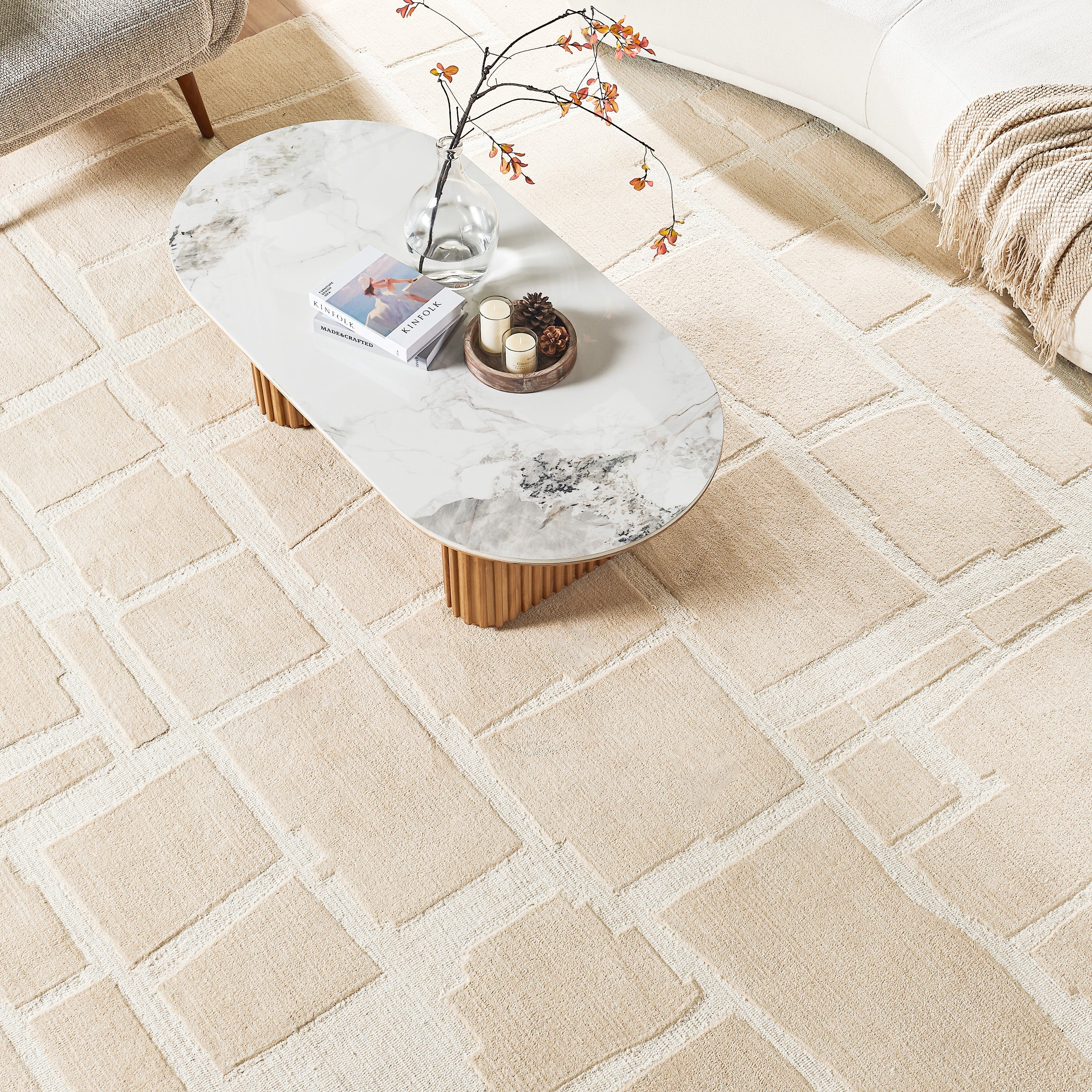
If you want a rug that adds texture without making the living room feel busy, the Benson Sketchline Wool-Blend Rug is a strong example of a tonal pattern done quietly.

Inspired by hand-drawn studies and architectural drafts, Benson features a soft sketchline grid with gently raised geometric blocks. The warm sand and ivory palette keeps the look calm and tonal.
It works especially well when you want the rug to add quiet structure, texture, and visual interest without overwhelming the rest of the living room.
View product →A rug does not need to match the sofa, curtains, and walls exactly. A little contrast helps the room feel layered.
Warm beige and cool gray can clash if the rest of the room has a different undertone.
Dark rugs can be beautiful, but they may make a small or low-light room feel smaller.
A pattern works best when it connects to the room’s palette and does not compete with every other detail.
Neutral colors such as ivory, beige, sand, taupe, and warm gray are some of the most versatile choices for living rooms. They work with many sofa colors, flooring types, and furniture styles.
Either can work. A lighter rug can brighten the room, while a darker rug can create contrast and grounding. The key is to avoid choosing a rug that blends too closely with the sofa.
Light rug colors such as cream, ivory, beige, and soft warm gray can make a living room feel more open and spacious, especially when paired with lighter walls and natural light.
Yes. Patterned rugs can add depth and help hide everyday wear, especially when the pattern is subtle, tonal, and connected to the rest of the room’s color palette.
The right living room rug color should make the furniture, flooring, and natural light feel more connected. It does not need to be loud to make an impact.
In many modern homes, a warm neutral or tonal patterned rug is the easiest way to add softness, structure, and quiet visual interest.
Explore the Benson Rug →

Share:
Rectangular Rugs vs Round Rugs: How to Choose the Right Shape for Your Home
Outdoor Wall Sconces: How to Choose the Right Style for Modern Homes